
During the facade access system selection phase of a high-rise building project, the most frequently asked question is: "Should we use a monorail system or a rail-mounted BMU?" Both systems offer permanent facade access solutions; however, the right choice — based on the building's architectural structure, rooftop geometry, and long-term usage needs — can make a significant difference.
What Is a Monorail System?
A monorail system is a facade cleaning system that travels along a single aluminum rail anchored to specially manufactured brackets mounted on the building's facade, inside the parapet, on the rooftop, or under the eave. The trolley mechanism traveling along the rail carries the suspended platform (cradle) horizontally and vertically across the entire facade.
Also known as a climbing monorail system in the industry, this system stands out for its ability to transition from one level to another in buildings with different floor heights. The trolley mechanism operates smoothly even at 90-degree corners.
What Is a Rail-Mounted BMU System?
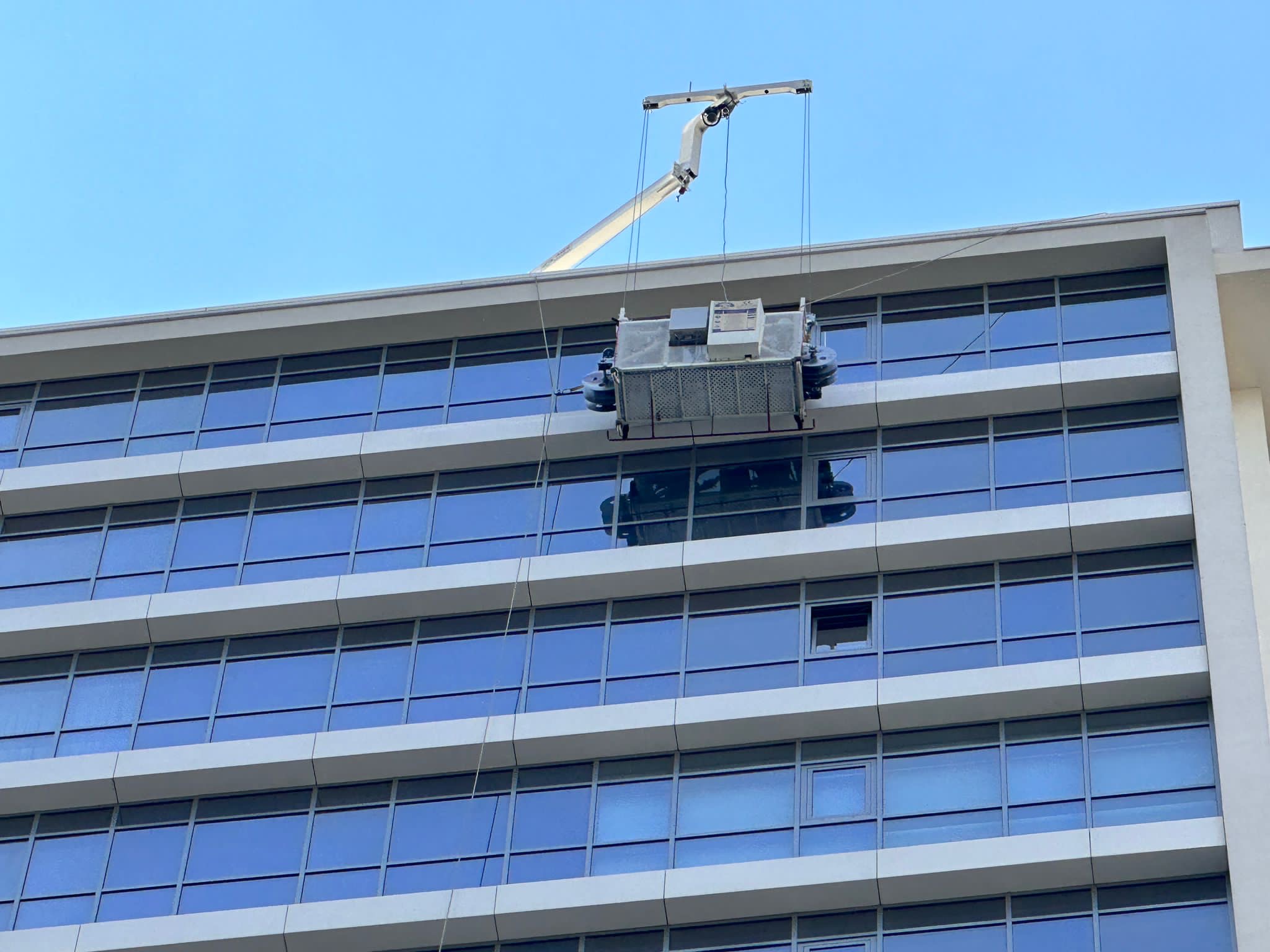
A rail-mounted BMU (Building Maintenance Unit) is a large-scale building maintenance unit that travels on double-track rails laid on the rooftop terrace, equipped with a telescopic or fixed boom. Moving freely across the terrace, it provides access to every point of the facade through boom rotation and extension.
Also known as a rail facade cleaning system, this structure delivers maximum efficiency in large-scale buildings with wide terrace areas and flat facades.
Key Differences: Monorail vs Rail-Mounted BMU
| Monorail System | Rail-Mounted BMU | |
|---|---|---|
| Rail type | Single aluminum rail (facade-mounted) | Double-track rail (rooftop-mounted) |
| Rooftop area required | Minimal — no rooftop area needed | Significant — wide terrace required |
| Buildings with level changes | Suitable (climbing mechanism) | Limited |
| Corner transitions | Smooth up to 90 degrees | Limited |
| Load capacity | 240 kg (standard) | High (project-specific) |
| Cost | More economical | Higher |
| Ideal building type | Mid-scale, complex facades | Large, flat-facade skyscrapers |
When Should You Choose a Monorail System?
The monorail facade cleaning system is the more suitable solution in the following situations:
- When there is insufficient rooftop space for a BMU
- When the building has a stepped structure at different levels
- When the facade has recesses, corners, or complex geometry
- When budget is limited and an economical solution is needed
- For mid-rise buildings (10–30 floors)
The monorail system's greatest advantage is its climbing mechanism — in buildings with level changes, the system transitions from one level to another, providing access to the entire facade. This feature offers a major advantage especially in stepped residential projects.
When Should You Choose a Rail-Mounted BMU?
The rail-mounted BMU system is the more suitable solution in the following situations:
- In skyscrapers and large plazas with wide rooftop areas
- When high access capacity is required for flat, wide glass facades
- In projects requiring heavy equipment handling (glass panel replacement, etc.)
- In large structures with intensive and continuous maintenance needs
Common Safety Standards in Both Systems
Work safety is the most critical element in both monorail and rail-mounted BMU systems. Safety features that must be standard in both types of Aser Makina systems include:
- Mechanical brake system and limit switches
- Overload mechanism
- Emergency stop button
- Automatic securing upon power failure
Both systems must meet EN1808 and CE certification requirements.
Which System Should You Choose?
The short answer: the decision should be based on your building's architectural structure and rooftop geometry. However, for the vast majority of residential and commercial building projects in Turkey, the monorail system offers a more economical, flexible, and practical solution. Rail-mounted BMU is ideal for large-scale skyscrapers with wide terraces, such as Istanbul Financial Center.
Before starting any project, facade geometry, rooftop area, and long-term maintenance needs must be analyzed. At Aser Makina, we design, manufacture, and install both systems.
Conclusion
The choice between a monorail system and a rail-mounted BMU is shaped by the building's size, rooftop area, facade geometry, and budget. Both systems deliver excellent results in the right project — what matters is making the right match.
Contact us to get information about the right facade cleaning system or monorail system for your project: Get in Touch.